🔔 A Journey of Sound, Synchronicity & Stewardship
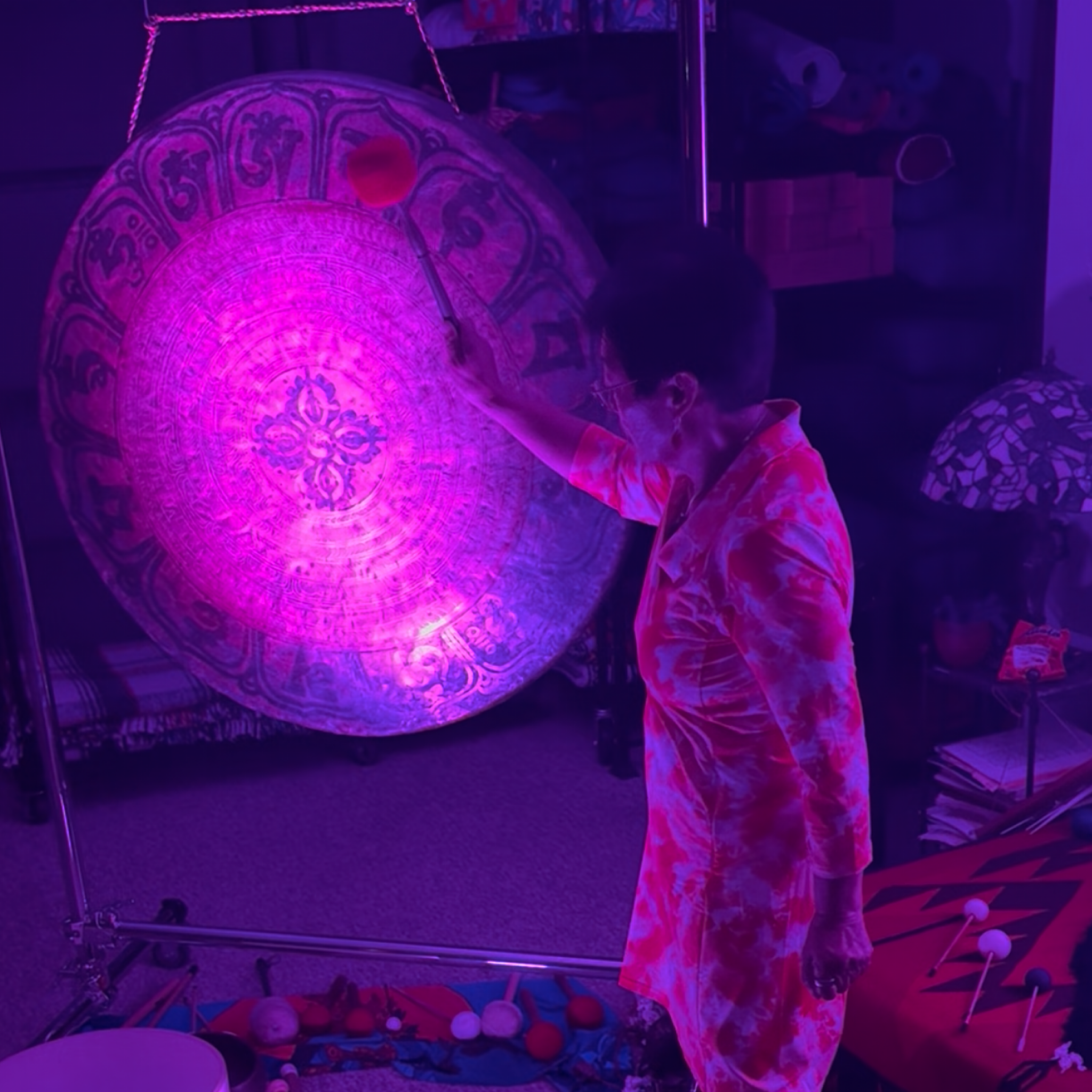
Kat Baker and the 40” Om Mani Padme Hum Nepalese Hymalayan Singing Bowl Gong.
A Story of Listening, Lineage & the Extraordinary Gongs Arriving at the Hive
Some instruments we purchase.
Others seem to find their way into our lives, carrying stories, journeys, hands, places, and years of being listened to and loved.
My relationship with the gong began twenty years ago. But what is unfolding at the Hive now feels like something altogether different.
After more than three years of watching and waiting, two extraordinary 40-inch gongs are being reunited. And after speaking with their original owners, Dean and Kat Baker, I now understand just how remarkable their journey has been.
This is becoming a story not simply about acquiring instruments.
It is about listening, discernment, synchronicity, lineage, and stewardship. 🐝✨
🌎 Our Ancient Relationship With Sacred Sound
Long before we had words such as stress response, mindfulness, or nervous-system regulation, human beings understood something through experience:
Sound can change the atmosphere of a space~and our experience within it.
Across cultures and spiritual traditions, bells, gongs, drums, chanting, singing, rattles, bowls, and other resonant sounds have accompanied prayer, meditation, ceremony, ritual, and community gathering.
A bell rings.
A drum begins.
A voice chants.
A gong sounds.
And something shifts.
Our attention is invited away from the endless stream of thought and toward something immediate: listening, feeling, breathing, and being present.
While the histories and meanings of these sacred practices are distinct and deserve to be honored as such, the human relationship with intentional sound crosses cultures, centuries, and spiritual traditions.
🧘🏽♀️ My First Gong | California, 2006
My personal relationship with the gong began in 2006, when I received my first gong from California—a beautiful 32-inch Nepalese Nipple Gong.
There is something rather fun about its story: I was told that an exact twin of this gong was purchased by British singer, songwriter, and record producer Seal.
But for me, the deeper relationship with the gong developed through my exploration of Kundalini Yoga and sound current.
Within my practice, the gong became part of a much larger journey.
We might begin with conscious breathwork and dynamic yoga postures, move through chanting and rhythmic breathing, and eventually enter stillness.
By the time the gong begins to speak, we have already spent time breathing, moving, sounding, feeling, and meeting ourselves.
Then comes the invitation to receive.
For me, the gong has often accompanied practices centered around the heart, awareness, and creating the conditions in which stillness can begin from the inside out. 💗
👁️ Then Came the Guidance: Another Gong
More than three years ago, I received guidance from my spiritual guides that another gong would eventually come to the Hive.
I didn't know which gong.
I didn't know where it would come from.
And I certainly didn't know its story.
So I went into what I lovingly call watch mode.
And I stayed there.
At one point, I even traveled out of town to attend a workshop where there were more than 50 gongs gathered in one room, many of them available for purchase.
I thought surely one would speak to me.
I listened.
I walked among them.
I felt into them.
I played many of them.
And...
Nothing.
Not one.
I was stunned.
Here I was, surrounded by more gongs than I could possibly have imagined, already carrying this inner knowing that another gong would come ~ and yet everything within me said:
Not these. Not yet.
So I went home without one.
That experience stayed with me.
Because sometimes guidance doesn't mean now.
Sometimes it simply asks us to become aware.
To listen.
To remain curious without grasping for the outcome.
To recognize the difference between wanting something and knowing when something is truly ours to tend.
And then, often when we least expect it, circumstances begin aligning.
Guidance meets opportunity. Intuition meets timing. And manifestation begins taking form. ✨
🔔 And Then I Found the Gong
Last year, one finally spoke to me.
A magnificent 40-inch gong, beautifully engraved with the mantra Om Mani Padme Hum, a mantra deeply associated with compassion within Tibetan Buddhist tradition, which has touched me through the years.
But I didn't yet know the fullness of what had found its way to the Hive.
Now I do.
And its provenance makes me appreciate this instrument even more.
🏔️ From Nepal to America | The Story Behind These Gongs
According to their longtime caretakers, Dean and Kat Baker, these remarkable 40-inch gongs were brought from Nepal into the United States in 2011 by Mitch Nur, a longtime ethnomusicologist, sacred-sound researcher, practitioner, and teacher.
Mitch's work with Himalayan singing bowls began in the 1970s and has included field research in Nepal and the Himalayas. His work continues today through teaching and research into sacred sound instruments, including gongs and Himalayan singing bowls internationaly.
And Dean and Kat were there when these particular instruments arrived.
Dean remembers going to Mitch's home and unpacking the gongs themselves from straw-filled pallets.
I love that image.
Before the sound baths.
Before the ceremonies.
Before the Hive.
Before I had any idea these instruments existed...
There they were, emerging from straw after their journey from Nepal.
And what they were unpacking was extraordinary.
✨ 200 Himalayan Singing Bowls Become One Gong
I learned from Dean and Kat that each of these 40-inch gongs was created in Nepal from approximately 200 Himalayan singing bowls.
Two hundred individual bowls.
Melted together.
Then hand-forged into an entirely new instrument.
That detail stopped me.
I had already been fascinated by the idea that multiple singing bowls had gone into their creation. But two hundred?
There is something deeply moving to me about it.
So many individual voices surrendered into the fire and became something they could never have become separately.
Many voices becoming one.
And unlike an orchestral gong manufactured toward a particular musical pitch or specification, these singing-bowl gongs were hand-forged without exact tuning.
That makes them beautifully unpredictable.
Complex.
Individual.
A little mysterious.
Their sounds aren't something I want to completely control.
They are something I want to meet.
🎶 The Gong Is Never Quite the Same
Dean shared another observation that fascinates me:
These gongs change according to the person playing them and the environment in which they are played.
From an acoustical perspective, that makes sense to me. The player's technique, mallet, striking position and force influence which frequencies and overtones emerge, while the size, shape, materials, surfaces, and acoustics of a room influence how those sounds are experienced.
But experientially, there is something even more beautiful about it.
The same instrument can reveal something different in different hands.
A different room.
A different gathering.
A different moment.
Perhaps that is why developing a relationship with a gong feels so different from simply owning one.
You continue discovering it.
🐝 And Now, Two Are Being Reunited
This is where the story becomes even sweeter.
Another one of these extraordinary 40-inch gongs is now coming to the Hive.It will join the one already here.
These instruments entered the United States together in 2011.
Dean and Kat were there to unpack them.
They lovingly cared for them for years.
And now, two of these remarkable gongs will reside together at the Hive.
After more than three years of waiting for the guidance I received to reveal itself, I could never have manufactured this particular story.
Sometimes manifestation isn't about chasing what we want.
It is about remaining awake enough to recognize what has finally come into alignment.
And soon we will hear what happens when these two enormous, hand-forged, beautifully unpredictable voices are played together. 🔔✨🔔
🩵 The Forgotten Gong
There is one more story I didn't know until speaking with Dean and Kat.
Our 26-inch Nipple Gong, which came to the Hive in 2026 and now resides in Hive 2, had quite an unlikely beginning.
Kat discovered it in 2014 during an out-of-business sale.
It wasn't beautifully displayed.
It wasn't presented as something precious.
It was tucked away in a warehouse behind junk, pallets, and covered in rat droppings.
She saw something worth saving.
She brought it home.
She cleaned it.
She cared for it.
And they loved it.
Years later, that same gong found its way to us.
I find something incredibly touching about that story.
An instrument can be forgotten behind discarded things ~ and still retain a voice waiting to be heard.
Today, its unusually high copper content gives it another distinctive quality within our growing family of gongs. This beauty is possibly from Thailand.
And it now has a home in one of our private treatment rooms, where its sound can be experienced in a much more intimate setting.
🤲 From Ownership to Stewardship
Learning all of this has changed something for me.
I don't really feel that I am simply buying gongs anymore.
I feel as though I am becoming the next caretaker in their story.
These instruments have traveled.
They have passed through hands.
They have been played, protected, cleaned, transported, listened to, and loved.
Dean and Kat have cared for them dearly.
And now I have the honor of continuing that care.
There is humility in that.
We don't know who will play them decades from now.
We don't know where their journey will eventually lead.
But for this chapter of their story, they are entrusted to the Hive.
And we get to listen. 🩵
🧠 What Is Science Discovering About Therapeutic Sound?
Alongside this ancient human relationship with sound, modern researchers are asking a very different question:
What happens psychologically and physiologically when people intentionally rest and listen?
Research into singing bowls, gongs, and therapeutic sound is still developing, but the findings are intriguing.
A 2017 observational study of 62 adults participating in a sound meditation using singing bowls, gongs, bells, and other instruments found significant post-session reductions in tension, anger, fatigue, and depressed mood, along with increased spiritual well-being.
A 2025 systematic review examining 19 clinical studies, including nine randomized controlled trials, found promising evidence for singing-bowl interventions involving anxiety, depression, sleep quality, and cognitive function, while also emphasizing the need for additional rigorous research.
And a 2026 randomized controlled trial studied 100 adults participating in four weeks of sound-based meditation incorporating singing bowls, gongs, bells, and tingshas. Compared with a music-control group, the sound-meditation participants showed greater short-term improvements in anxiety and depressive symptoms, along with reductions in salivary cortisol and blood pressure.
Because these therapeutic experiences incorporate several instruments and practices, these results cannot be attributed to the gong alone.
But they add another fascinating piece to the growing exploration of intentional sound and human well-being.
Science isn't proving ancient spiritual beliefs about sound.
It is beginning to ask measurable questions about experiences human beings have been drawn to for generations.
And I find that intersection fascinating.
🧠 Curious About the Research?
As someone who deeply values the meeting place between ancient wisdom, lived experience, and modern research, I believe it is important to remain curious about what science is discovering about therapeutic sound. The research is still developing, and these studies do not suggest that gongs alone are responsible for every reported benefit. Rather, they offer an intriguing look at how intentional sound experiences—including singing bowls, gongs, bells, and other resonant instruments—may support relaxation, mood, stress reduction, and overall well-being.
For those who enjoy going a little deeper into the science, here are three studies and reviews worth exploring:
Goldsby et al. (2017) — Effects of Singing Bowl Sound Meditation on Mood, Tension, and Well-being: An Observational Study. Published in the Journal of Evidence-Based Complementary & Alternative Medicine. Sixty-two adults participated in a sound meditation that included singing bowls as well as gongs, bells, didgeridoo and other instruments. After the meditation, participants reported significantly less tension, anger, fatigue, anxiety and depressed mood, while spiritual well-being increased. Because this was an observational pre/post study rather than a randomized controlled trial, it shows an association with the sound-meditation experience rather than proving that the instruments caused the changes.
Read the Goldsby et al. study on PubMedLiu et al. (2025) — Therapeutic Effects of Singing Bowls: A Systematic Review of Clinical Studies. This systematic review brought together the existing clinical literature rather than relying on a single experiment. It found promising evidence across psychological outcomes including stress, anxiety and depression, as well as some physiological measures. The review also makes an important point for your readers: the quality and consistency of the evidence varies considerably, and stronger clinical trials are still needed.
Read the 2025 systematic review on PubMed2026 randomized controlled trial — sound meditation using singing bowls, gongs, bells and tingshas. This study involved 100 adults and compared four weeks of supervised sound meditation with a music-control condition. The sound-meditation intervention incorporated multiple instruments, including gongs, and reported greater short-term improvements in anxiety and depressive symptoms along with reductions in salivary cortisol and blood pressure. Importantly, because the intervention combined several instruments, the findings should not be interpreted as evidence that the gong alone produced these effects.
View the 2026 study record on PubMed
🌿 When Life Has Become Too Loud
Perhaps therapeutic sound speaks so deeply to us because modern life rarely becomes quiet on its own.
You may recognize yourself here if you have been:
✨ Mentally overloaded and unable to quiet your thoughts
✨ Carrying stress long after the stressful moment has passed
✨ Feeling constantly “on” or responsible for everyone and everything
✨ Physically tense from work, caregiving, or emotional demands
✨ Tired, yet finding it difficult to truly settle
✨ Emotionally depleted or overstimulated
✨ Longing to meditate but finding silent meditation difficult
✨ Disconnected from your body or inner world
✨ Craving a space where, for a little while, nothing is required of you
One of the things I love most about sound meditation is that you don't necessarily have to force your mind to become quiet.
You can simply listen.
A gong sounds.
You follow the vibration.
Another overtone appears.
It fades.
Something quieter emerges underneath it.
And eventually, you may find yourself listening just as deeply to the silence between the sounds.
Perhaps that is part of the medicine of intentional listening:
not escaping ourselves, but becoming present enough to hear ourselves again.
🔔 Listening Begins Before the Gong Is Struck
Twenty years after my first gong entered my life, our sacred sound family has become something I could never have planned.
My 32-inch Nepalese Nipple Gong from 2006.
The once-forgotten 26-inch Nipple Gong, discovered behind junk in a warehouse in 2014 and now loved at Hive 2.
Our extraordinary 40-inch gong hand-forged from approximately 200 Himalayan singing bowls.
And now...
its companion is coming home to the Hive.
Perhaps the greatest lesson these instruments have already given me is that listening begins long before the gong is struck.
Sometimes it begins with a whisper from Spirit three years earlier.
Sometimes it means standing in a room surrounded by 50 possibilities and having the discernment to choose none of them.
Sometimes it means waiting.
Sometimes it means rescuing something beautiful from behind a pile of forgotten things.
And sometimes it means receiving something that others have lovingly cared for and understanding that your role isn't simply to possess it.
Your role is to become its next good steward.
I am honored to continue caring for these extraordinary instruments.
And I am even more excited to share their voices with you.
May they remind us that transformation doesn't always require another thing to accomplish, analyze, or understand.
Sometimes we are simply invited to lie down.
Breathe.
Listen.
Receive.
And allow the sound to meet us exactly where we are. 🔔🩵🐝
I am grateful for Dean and Kat Baker’s guidance.🙏🏽
Bee Bold, Bee Wise, Bee Present!
With love and resonance,
Jaque Hanson
Bee Present Wellness